
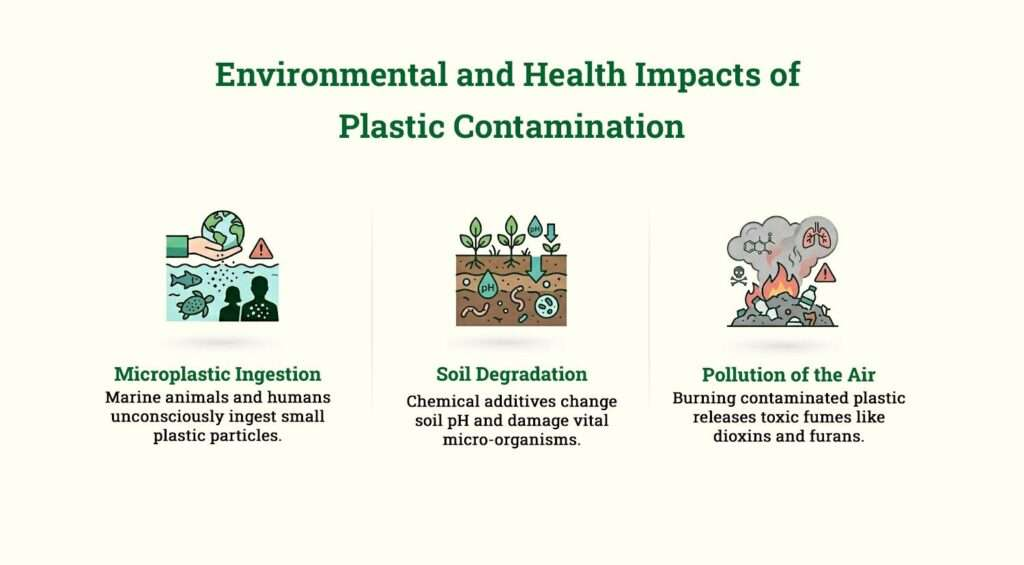
Plastic recycling is a fundamental concept for developing a sustainable economy. However, plastic contamination in plastic waste affects the quality and efficiency of the recycling process. This is mainly because, when mixed with dirt, labels, adhesive, or incompatible plastics, recycling becomes problematic. Organisations like Banyan Nation are helping address this challenge by using modern plastic recycling technologies that enhance the quality and recyclability of plastic waste. Understanding Plastic Contamination will enable industries and individuals to make informed decisions about plastic waste, ensuring it meets the expected quality standards for manufacturing purposes.
Understanding Plastic Contamination in Recycling
Plastic recycling is one of the most efficient methods for mitigating environmental pollution. Nevertheless, the plastic recycling process has encountered several challenges. One major challenge is plastic Contamination in Recycling.
Plastic waste may contain contaminants such as food particles, dirt, ink, labels, glue, and various types of plastic. This affects the recycling process and diminishes the overall value of recycled plastic materials.
Organisations like Banyan Nation are some of the top plastic recycling organisations in India. The organisation is committed to developing top-class plastic recycling plants that remove impurities from plastic waste. The systems then recycle the plastic into reusable raw materials. The company’s technology can recycle plastic waste into reusable granules for various manufacturing processes.
When contamination levels are high, recycled plastics cannot perform the same functions or achieve the same quality as non-recycled plastics.
What Is Plastic Contamination?
Plastic Contamination is the presence of unwanted substances or materials mixed with waste plastics during collection, sorting, and recycling processes.
Plastic Contamination can arise from improper waste disposal practices, poor waste segregation practices, and complex packaging arrangements.
Contaminations can manifest in many different forms, such as:
- The presence of food and other organic waste in packaging plastics.
- The presence of labels, adhesives, and printing inks attached to containers.
- The mixing of different kinds of plastics.
- The presence of dirt, sand, and moisture in waste plastics.
- The use of multi-layer packaging that is difficult to separate.
Even small amounts of contamination can affect the quality of recycled plastic batches.
Major Sources of Plastic Contamination
Plastic contamination can occur at various stages of waste management. This can improve the efficiency of recycling processes.
1. Improper Waste Segregation
One of the main reasons for plastic Contamination is the lack of proper waste segregation at the source, whether household or industrial.
- Plastics disposed of with food waste become difficult to recycle.
- The presence of moisture with waste degrades the quality of the plastic.
- The presence of mixed waste increases the cost of cleaning the waste.
Proper segregation at the source can significantly reduce contamination levels.
2. Mixed Plastic Polymers
Not all plastics are compatible with each other during the recycling process.
- PET, HDPE, PP, and PVC all have different recycling methods.
- If these plastics are mixed during the recycling process, the resulting recycled material is of poor quality.
- If these plastics are not sorted correctly, the resulting recycled material will be of poor quality.
Plastic Contamination like this is particularly problematic in automated recycling centres.
3. Labels, Adhesives, and Additives
In addition, plastic packaging may contain other materials that contaminate the recycled materials.
- Adhesives used in labels
- Colour pigments used in printing
- Metallic materials used in packaging
- These materials can contaminate recycled materials during the recycling process.
The company’s advanced cleaning technology helps remove these contaminants from the plastics before converting them into reusable material.
4. Multi-Layer Packaging
Many consumer products are packaged in multi-layer plastic packaging for increased durability or longer shelf life.
- These materials are a mix of different plastics packaged together.
- It is technically difficult to separate these plastics.
- Recycling becomes economically unfeasible.
Multi-layer plastic packaging is a major cause of Plastic Contamination in our recycling system.
How Plastic Contamination Affects Recycled Materials
In addition to interfering with the recycling process, plastic contaminants directly affect the quality of recycled materials.
1. Reduced Mechanical Strength of Recycled Materials
Recycled plastics are no longer strong when they are contaminated.
- Products made from recycled plastics are no longer strong; they are brittle or weak.
- Recycled plastics are no longer as durable as they used to be.
- Recycled plastics no longer perform as they should.
Manufacturers often hesitate to use recycled plastics when contamination levels are high.
2. Poor Appearance and Colour Quality
Colour contamination impacts the quality of the recycled materials.
- The mixed plastics have an inconsistent colour.
- The dark colours can migrate to other batches.
- Transparent plastics may turn opaque.
This impacts the recycled plastics used to make packages.
3. Chemical impurities
Another important consequence of plastic Contamination is chemical instability.
- The process of recycling plastics can cause the plastic to release harmful chemicals.
- Plastic recycling may produce odours.
- The recycled plastics may not comply with health and safety standards.
A number of industries require high-quality recycled plastics, such as food packaging, and contamination poses a significant risk.
4. Costs Associated with Recycling Have Increased
Additional processing is needed to remove harmful substances.
- More equipment for sorting and washing increases operating costs.
- Contaminated materials could be rejected from the recycling stream altogether.
- The efficiency of recycling will decrease.
Therefore, plastic contamination will adversely affect the ability of recycling operations to provide services economically.
Effects of Plastic Contamination on the Environment
Plastic contamination has a significant impact on both the quality of recyclable materials and the environment.
Contamination with plastic has the following consequences:
- A significant amount of refuse (i.e. waste) becomes unusable.
- Contaminated refuse is either sent to a landfill or incinerated.
- The circular economy is not sustained as much as intended and continues to deteriorate.
An estimated 50 million metric tons of plastic waste is produced globally every year, creating a demand for efficient recycling to build a more sustainable world.
A Study on How Technology Reduces Plastic Contamination
New technologies for recycling help address contamination issues.
For example, Banyan Nation offers its customers new methods to increase purity levels across their entire recycling supply chain.
There are various technologies that can be employed to ensure that the levels of impurities are minimised during recycling, including:
1. Advanced Sorting Systems
- Contemporary recycling processes employ automated technologies.
- Optical Sorters — identify polymers.
- Infrared Sensors — identify plastic compositions.
- AI enhances sorting precision.
These technologies reduce plastic contamination during initial material processing.
The Evolution of Clean Plastic Recycling
As sustainability has become increasingly important to both governments and businesses worldwide, the way that the global recycling industry operates is changing rapidly.
Many of the new technologies for sorting recyclables, tracking waste digitally, and creating circular economy systems have helped combat plastic contamination.
1. The focus of all Recycling Companies has shifted to:
- Increasing their material recovery rates.
- Creating Recycled Resins that are of the highest quality possible.
- Bringing informal waste pickers into negotiated Supply-Chain solutions.
- Implementing Transparent Recycling Systems.
With the right technology and legislation, recycled plastics can achieve a quality equivalent to that of virgin plastic.
Final Thought
Plastic Contamination is one of the most formidable barriers to the efficient recycling of plastics. This challenge has affected the quality and usability of recycled plastics. To effectively address this challenge, there is a need for improved waste segregation, packaging design, and more efficient recycling technology for plastics. Organisations like Banyan Nation are contributing immensely to addressing this challenge by developing innovative technologies that remove contaminants from plastics and generate high-quality recycled plastics for industrial use. This has greatly contributed to the creation of a circular economy in which plastics are used for productive purposes rather than polluting.