A lot of AI music platforms are described in ways that make every system sound identical. They all promise speed, creativity, and convenience, yet the user experience often collapses into one opaque button. The problem with that design is that music creation is rarely one-dimensional. Sometimes you need a fast sketch. Sometimes you need a more controlled vocal result. Sometimes you need a longer composition with more arrangement depth. A useful platform has to acknowledge those differences.
That is why ToMusic stands out less as a single generator and more as a small studio built around model choice. The idea is simple but important: different creative tasks should not be forced through the same musical engine. Instead of asking one model to do everything equally well, the platform gives users several generation paths. In my view, that makes the product easier to reason about and easier to use strategically.
The first impression a new user gets from an AI Music Generator is usually based on output quality. But the second impression, the one that lasts, depends on whether the system helps them make better choices. That is where ToMusic becomes more interesting than a basic text-to-song page.
Why Model Choice Changes User Expectations
When a platform exposes multiple models, it quietly teaches users that creative quality has dimensions. Not every track needs the same priorities. Some sessions are about experimentation, some about vocal realism, some about complex arrangement, and some about finishing a longer musical idea.
That framing reduces a common frustration in AI products: users often blame themselves when the output misses the mark, even though the issue may be that they used the wrong generation mode for the job. A multi-model design solves part of that by making trade-offs visible from the start.
Why V1 Suggests Speed Over Complexity
V1 appears to be the lighter entry point. It supports shorter songs and works well as a way to turn a rough concept into an audible reference quickly. This can be valuable for first drafts, content testing, or idea validation.
Why V2 And V3 Sit In The Middle
V2 seems positioned toward richer atmosphere and broader sound layering, while V3 leans toward fuller harmony and more complex arrangement. In practical terms, they occupy the middle ground between rapid sketches and more refined vocal-led tracks.
Why V4 Feels More Outcome-Oriented
V4 is presented as the model with more realistic vocals and more control. For users chasing stronger finality rather than simple exploration, that positioning matters. Even if results still vary by prompt, the promise is clearly about a more polished feel.
A Better Way To Understand The Product
Instead of viewing ToMusic as a feature list, it helps to read it as a decision system. The platform asks users to combine two kinds of choices:
- What type of musical idea are you starting with?
- What kind of result do you want this session to prioritize?
That sounds obvious, but many tools skip this layer entirely. Here, the workflow begins to make sense only when you see how prompt type and model type interact.
How Prompt Type Reshapes The Creative Session
ToMusic supports descriptive prompts and lyrics-based generation. These two entry points may look similar on the page, but they serve different users and different mindsets.
Prompt-Led Sessions Start With Atmosphere
A descriptive prompt is ideal when the creator knows the emotional or stylistic zone of the track, but not the actual words. This approach is well suited to background music ideas, conceptual demos, short content scoring, or tonal experimentation.
Lyrics-Led Sessions Start With Message
Lyrics-first work begins with language that already has shape. That pushes the session toward phrasing, vocal presence, and section flow. It is a better fit for creators who think in verses and choruses rather than textures and genres.
Why The Same Tool Can Feel Different
The product can therefore feel like two tools inside one interface. One side is more atmospheric and exploratory. The other is closer to early song realization. This split is useful because it respects different creation habits instead of forcing everyone into the same process.
A Three-Step Workflow That Matches The Official Logic
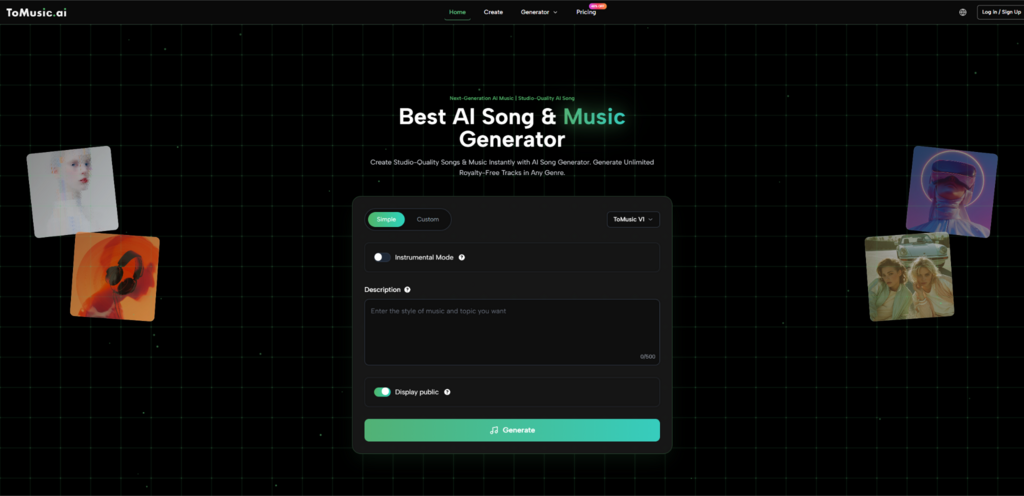
The platform’s core flow remains relatively direct, which is part of its usability.
Step 1. Select The Model That Matches The Goal
The user chooses V1, V2, V3, or V4 based on what matters most in that session: speed, depth, arrangement complexity, or vocal realism.
Step 2. Enter A Prompt Or Paste Lyrics
Next comes the actual creative brief. This may include genre, mood, tempo, instrumentation, or lyrics. The point is to provide a clear musical direction rather than a pile of unrelated adjectives.
Step 3. Generate And Evaluate The Result
After generation, the track can be reviewed, saved, and compared against alternate attempts. In practice, this comparison stage is where many users begin to understand which model suits them best.
How The Platform Encourages Comparison Instead Of Blind Trust
One subtle strength of ToMusic is that it lets users compare outcomes across models instead of pretending every result should be judged in isolation. That matters because creative evaluation is relational. A track may sound good on its own, but only after hearing another model’s version do you realize it lacks emotional weight or structure.
| Creative Need | Better Starting Direction | Why It Makes Sense |
| Quick concept testing | V1 | Faster draft logic |
| Atmosphere-focused music | V2 | Broader sound layering |
| Richer arrangement ideas | V3 | More harmonic complexity |
| Stronger vocal presence | V4 | More realistic delivery |
This table is useful not because it locks users into rigid rules, but because it gives them a more informed first guess.
Why Lyrics-Based Generation Deserves Separate Attention
Many discussions about AI music stay too focused on prompt writing and overlook how different the experience becomes when lyrics are the starting point. On ToMusic, Lyrics to Music AI is not just another feature label. It represents a different creative logic.
A lyrics-based session has a built-in dramatic structure. Words imply emphasis, emotional pacing, and melodic pressure. Even if the final result still needs revision, hearing lyrics placed inside a generated composition can reveal whether the song idea has enough tension and release to justify further work.
What Lyric Writers Gain From Hearing Early Drafts
Writers can discover whether their lines are too dense, too repetitive, or too flat once melody enters the picture. This is one of the most practical uses of AI-assisted music: not replacing the writer, but giving the writer faster feedback.
Why Non-Singers Still Benefit
A person does not need to be a vocalist to learn from generated singing. Sometimes hearing a track performed in any form is enough to expose weak transitions, underpowered choruses, or mismatched emotional tone.
What The Asset Side Adds To The Experience
The platform also saves generated songs into a music library and preserves related metadata such as titles, lyrics, descriptions, and parameters. That may sound secondary, but it solves a real problem. Creative exploration becomes less useful if drafts disappear or become impossible to track.
Why Saved Outputs Matter For Iteration
When a user can revisit prior versions, compare prompts, and trace what produced a certain result, the creative process becomes more systematic. That turns generation into a repeatable workflow rather than a stream of disconnected experiments.
Where Expectations Should Stay Grounded
No AI music product should be judged as though it removes the need for taste, revision, or selection. Outputs still depend on input quality, and some songs will require multiple generations before they feel usable. In my observation, better prompts improve odds, but they do not guarantee a perfect match every time.
Why Honest Friction Improves Trust
A platform becomes easier to trust when it does not need to be framed as effortless genius. The real value here is not certainty. It is momentum. ToMusic helps creators test ideas faster, compare paths more clearly, and move from abstraction to draft without needing a full production setup first.
Why That Matters More Than Novelty
The novelty of text-to-music will eventually fade. What remains important is whether a product helps people create more intentionally. On that measure, ToMusic’s multi-model structure is its most convincing design choice.
What This Means For The Future Of Song Drafting
The broader significance of platforms like ToMusic is not that they can generate music on demand. It is that they are normalizing a new early-stage workflow: choose a generation strategy, feed it a meaningful brief, listen critically, and iterate. That is closer to creative collaboration than one-click automation.
For users willing to approach it that way, ToMusic feels less like a gimmick and more like a studio assistant with multiple rooms. Each room sounds a little different. The real skill lies in knowing which door to open first.